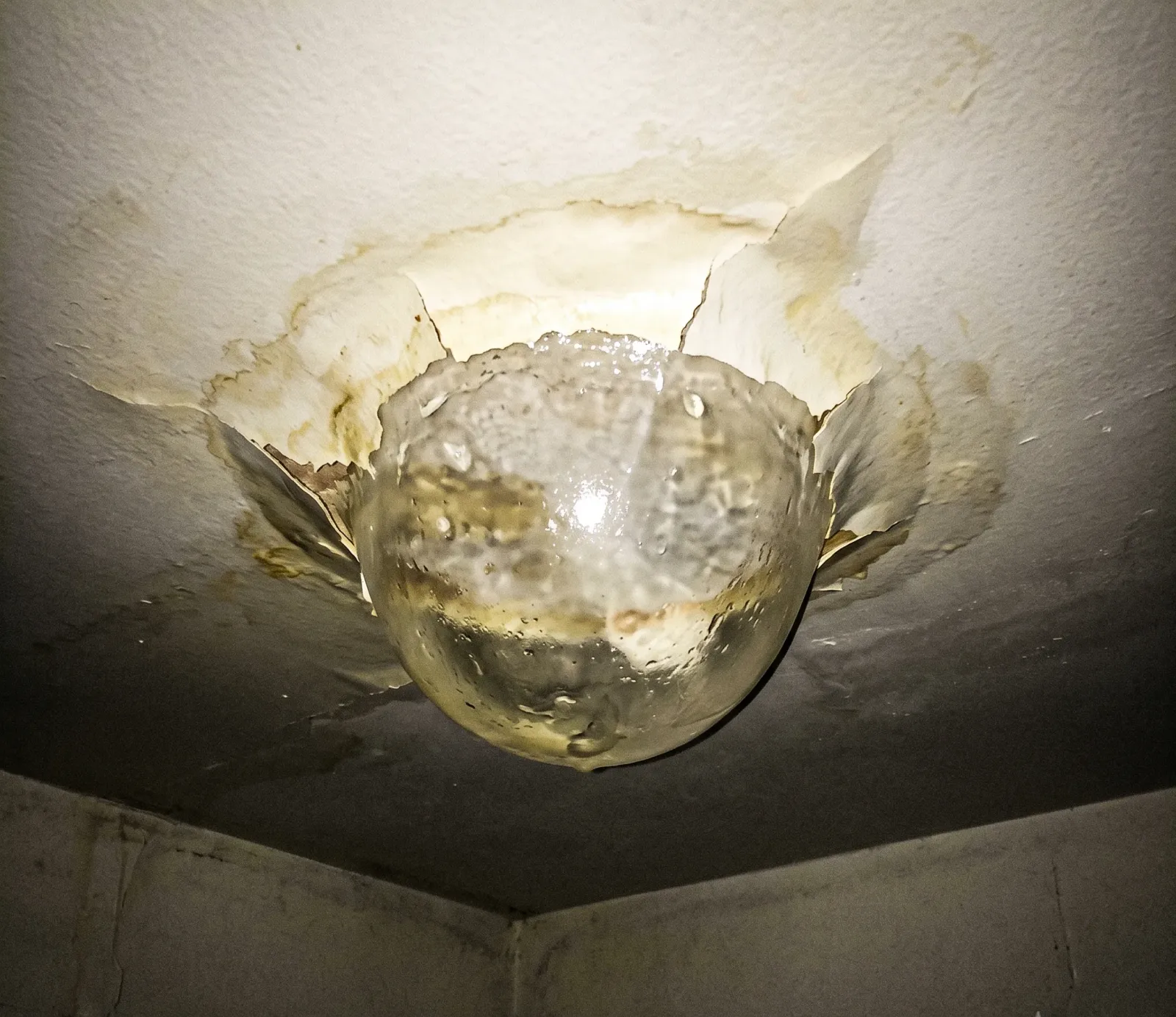
Why Flat and Low-Slope Roofs Leak in FL
Why flat and low-slope roofs in Fort Lauderdale fail, and where the water actually gets in.
Flat roofs leak from a handful of repeatable points: clogged roof drains or scupppers that let water pond, failed seams on built-up or modified bitumen membranes, broken flashing at parapet walls, and worn seals around roof penetrations like vents and AC lines. In Fort Lauderdale, hurricane season rain finds every one of these at once.
Why Flat Roofs Fail in This Climate
A flat roof is not actually flat. It has a low slope, often less than a quarter inch of drop per foot, just enough to move water toward a roof drain or scupper. In Fort Lauderdale, that slight pitch fights a losing battle against tropical downpours that can drop inches of rain in an hour. When the slope is off by even a little, water sits instead of draining, and ponding water becomes the starting point for almost every leak that follows.
Commercial buildings across Fort Lauderdale, from strip plazas off Oakland Park Boulevard to office buildings downtown, rely on low-slope systems because flat roofs are cheaper to build over large spans. Condo and townhome buildings near the Intracoastal and in neighborhoods like Coral Ridge and Imperial Point often carry the same flat-roof sections over garages, breezeways, and additions, even when the main roof is pitched. The failure points are the same whether the building sells insurance or holds a boat lift out back.
Ponding water is not a cosmetic issue. Water sitting on a membrane for more than 48 hours after a storm starts breaking down the surface through UV exposure trapped under standing water, and it adds weight the roof deck was not built to hold indefinitely. A flat roof that ponds after every hurricane season storm is telling you the drainage was undersized, blocked, or pitched wrong from the start, and that problem gets worse, not better, with each named storm.
Ponding Water and Drainage Weak Points
Membrane seams are the most common failure point on a built-up roof or modified bitumen system. These roofs are assembled in overlapping sheets, and every seam is a place where heat-welding or adhesive can fail years after installation. Seam failure rarely happens all at once. It starts as a small lift at a corner or edge, invisible from the ground, and widens every time wind gets under it during a tropical downpour or a stronger blow off Port Everglades.
Roof coatings are meant to extend the life of an aging membrane, not replace one that has already failed underneath. A coating applied over blistering or existing seam separation can trap moisture rather than seal it out, which is why a fresh-looking roof can still leak into a Fort Lauderdale condo unit or commercial space below. Blistering itself, small raised bubbles in the membrane surface, signals trapped moisture or gas pushing up from underneath, and it is a sign the roof deck below may already be wet.
- Roof drains and scuppers clog with palm debris and grit blown in off the Intracoastal, backing up water faster than a tropical downpour can drain through a working outlet.
- Ponding water that sits past 48 hours softens the membrane and adds weight the roof deck was never built to hold season after season.
- Flashing at parapet walls pulls away as the building moves with heat and humidity, opening a gap right where two materials meet.
- Seam failures develop where sheets of membrane overlap, often the first place a low-slope roof gives up during hurricane season.
- Roof penetrations for vents, AC lines, and satellite mounts get resealed poorly during other work, leaving a path straight to the deck.
- Blistering shows up as raised bubbles where trapped moisture or air expands under sun exposure, weakening the membrane from beneath.
Membrane, Seam and Flashing Failures
Ponding water sits on flat sections near Fort Lauderdale roof drains and scuppers long after a tropical downpour ends, since low-slope roofs rely on slight pitch rather than gravity to clear water fast. Weight from standing water stresses the membrane and speeds blistering. Once a seam opens or flashing pulls loose at a parapet wall, water tracks sideways under the roof deck before it ever shows indoors.
Roof penetrations, anything punched through the deck for a vent stack, an air conditioning line, or a satellite mount, are sealed at installation but rarely resealed on a schedule. Every penetration is a manufactured weak point, and on a building near the Intracoastal or a canal, salt air accelerates the breakdown of sealants faster than it would inland. A single failed boot around a pipe penetration can move enough water into a roof deck to cause sagging tile or a soft spot in a ceiling below, long before anyone sees a drip.
- A built-up roof relies on alternating layers of tar and felt, common on older commercial buildings around Downtown Fort Lauderdale and Sistrunk.
- Modified bitumen sheets are torch-applied or cold-applied in single or multiple plies, and show up on newer low-slope homes near Coral Ridge and Imperial Point.
- Single-ply membranes are thinner sheets fully adhered or mechanically fastened, and depend heavily on clean, intact seams to stay watertight.
- A roof coating adds a protective layer over an existing system but cannot substitute for repairing a torn membrane or failed flashing underneath it.
Common Failure Points Compared
Roof drains and scuppers are the release valves for a low-slope roof, and they only work if they stay clear. A roof drain clogged with palm debris, roofing granules, or standing sediment turns a normal Fort Lauderdale downpour into a pond within minutes. Scuppers, the through-wall openings that let water exit at a parapet, fail the same way when leaves or debris pack into the opening, and both problems are worse on buildings that go weeks between roof inspections.
A blocked drain does not just cause ponding, it can overload the roof structure during a heavy storm. Flat roofs are engineered around the assumption that water leaves within a set window, not that it stacks up over a full drain cycle. When a scupper or drain stays blocked through a tropical downpour, the ponding water on a roof over Sistrunk, Melrose Park, or any commercial strip nearby can reach a depth that stresses the roof deck itself, not just the membrane sitting on top of it.
| Failure Point | What Goes Wrong | Where It Shows Up Inside |
|---|---|---|
| Roof drains and scuppers | Debris blocks flow, water backs up | Ceiling stains near exterior walls |
| Seam failure | Heat-welded or adhered seams separate | Random ceiling drips, hard to trace |
| Flashing at parapet walls | Metal or membrane flashing pulls loose | Top-floor exterior wall staining |
| Roof penetrations | AC units, pipes, vents lose their seal | Water tracks along ductwork or pipes |
| Roof deck saturation | Insulation below the membrane holds water | Soft, sagging ceiling sections |
Parapet Walls and Roof Penetrations
The roof deck is the structural layer underneath the membrane, and it is the part nobody sees until a leak has already been running for a while. Plywood or metal decking that stays wet under a failed seam or flashing detail can soften, delaminate, or corrode long before a stain appears on the ceiling below. By the time a tenant in a building near Sunrise Boulevard notices a brown ring overhead, the roof deck underneath may already have been absorbing water for weeks.
Built-up roofs, layers of asphalt and felt topped with gravel or a cap sheet, hide deck problems especially well because the gravel layer masks blistering and minor ponding from a ground-level glance. Modified bitumen systems show surface damage more readily but still rely on a sound deck underneath. Either way, a flat roof that looks fine from the parking lot can already have a saturated deck, and that is not something a homeowner or property manager can diagnose without getting on the roof.
What Happens Once Water Gets Under the Membrane
Fort Lauderdale's hurricane season, June through November, is when most flat roof failures turn into interior water damage. Wind-driven rain finds every weak seam, open flashing joint, and clogged drain a roof has been hiding for months, and it does it all at once during a single storm rather than gradually. A roof that has ponded quietly for a year with no visible interior sign can leak into multiple rooms during one tropical downpour, because the storm is testing every weak point simultaneously.
Rooftop mechanical units and rooftop access hatches are their own category of penetration risk, common on commercial buildings and larger condo properties from Victoria Park to Coral Ridge Isles. Vibration from HVAC equipment can work a seal loose over time even without a storm involved. Anyone managing a flat roof in this market benefits from checking these penetrations, the drains, and the low points on the membrane on a regular schedule, rather than waiting for a ceiling stain to force the issue.
Flat Roof Terms to Know
- Fort Lauderdale's Stormwater Operations division runs a 24-hour call center for flooding and clogged drain reports, per fortlauderdale.gov.
- A flat roof deck that stays saturated under a blistered membrane can feed water into ceilings for days before a stain ever appears indoors.
- Built-up roofs layer tar and felt; modified bitumen uses torch or cold-applied asphalt sheets instead.
- Flashing failures at parapet walls are a common leak point as coastal buildings expand and contract with heat.
- Scuppers and roof drains need regular clearing near the Intracoastal, where palm debris and grit collect fast.
- A roof coating protects a sound membrane but does not repair an active seam failure or damaged flashing.
Frequently Asked Questions
Why does my flat roof leak after every storm?
Ponding water becomes a real problem after about 48 hours, when UV breakdown under standing water accelerates and the extra weight starts stressing the roof deck. In Fort Lauderdale, a roof that still holds water two days after a tropical downpour has a drainage or slope problem that needs a licensed roofing pro, not just a drain cleared once.
What is ponding water on a flat roof?
Ponding water is standing water that sits on a flat roof for more than 48 hours after rain instead of draining. Fort Lauderdale's flat commercial buildings and low-slope homes near Coral Ridge and Victoria Park see this often after a tropical downpour, and it stresses the membrane over time.
Are roof coatings enough to stop leaks?
A roof coating can extend the life of a sound membrane, but it will not seal an active seam failure, a cracked scupper, or damaged flashing around a parapet wall. Coating over a hidden problem near the Intracoastal or New River just delays a bigger repair.
How is a modified bitumen roof different from built-up?
Modified bitumen is a single or multi-ply asphalt sheet, torch or cold-applied, common on newer low-slope homes and additions around Fort Lauderdale. A built-up roof layers alternating tar and felt, often seen on older commercial buildings in Downtown Fort Lauderdale and Flagler Village.
Can a flat roof leak without any visible damage?
Yes. A seam failure or a small penetration around a vent pipe can let water travel sideways under the membrane before it ever reaches the roof deck below and shows on a ceiling. By the time a stain appears in Sunrise or Plantation, water has often been moving for weeks.
Found a flat roof leak?
Ponding water and a failing membrane will not fix themselves before the next tropical downpour. Call (954) 910-2507 now to reach the licensed pros we connect you with for a flat roof inspection.
Call (954) 910-2507